PART II – LIFE WITH CANCER AND TREATMENT (please see here)
PART III – LIFE WITHOUT A STOMACH
PART IV – RETURN TO WORK AND IMPACT OF CANCER (please see here)
PART V – FOLLOW UP: GOOD DOCTORS, BAD DOCTORS (please see here)
PART VI – CURRENT STATE & FINAL WORDS (please see here)
PART VII – SILENCE OF THE MOTHERS (please see here)
—————————————————————————————————————————————
PART III – LIFE WITHOUT A STOMACH

AFTER TREATMENT
After my treatment, my pain and fatigue continued for a long time, as seen in my photo. It took me a long time to feel good physically. It was not possible to fully return to the past anyway.

After the end of the treatment, I had monthly check-ups for a year. In the following years, we started check-ups every two months, then every three months, every six months, and then after 6 years, we started annual check-ups. After the twelfth year, I went back to 3-monthly check-ups all over again.

I want to start by saying that a lot happens. Since our digestive system loses its most important part, digestive and excretory problems begin. Not being able to drink water, difficulty swallowing, taking external supplements throughout life (because the food we eat needs to be processed in the stomach in order for the body to produce /absorb vitamin B12 and iron), bloating that sometimes starts with the first bite, not being able to vomit, gas problems, and completely eliminating some foods from your life.

Since there is no gastric valve (actually known as a valve, it is a condition that occurs when the muscles at the entrance and exit of the stomach are stretched), when you bend over for a long time, the food you eat or acid secretion comes into your mouth, and acid splashes cause great pain in your throat, especially at night. And most importantly, experiencing dumping syndrome is one of the first things that come to my mind.

And to patiently answer the question of where does the food you eat go if you don't have a stomach?

I would like to detail some of these to make them more understandable.

Dumping Syndrome: This is a very important syndrome we experience. The reason is that since we do not have a stomach, the food we eat passes directly into our small intestine, and since absorption begins immediately in the small intestine, if you eat something that will raise your blood sugar, your blood sugar will suddenly skyrocket.

The pancreas secretes insulin to lower high blood sugar, and this time your sugar drops too low, so you go into hypoglycemia. During hypoglycemia, my back feels like it's on fire, I start shaking and feeling extremely dizzy. To fix this situation, you need to raise your sugar again. You return to normal about 20 minutes after eating sugar.

Not being able to drink water: Since I don't have a stomach, when I drink water it goes straight down and causes pain. To avoid this, I have to drink it in small sips. Water is incredibly unpleasant when drunk this way. I was drinking fruit compote with very little sugar for fluid intake. Then I started drinking iced tea. At least it didn't require small sips since it had a taste. Even though I can now drink a few sips in a row, I still cannot drink water.

I'm not alone in this. There are many patients in my situation. One person said that he started drinking water after 15 years. I hope I can drink it too one day.

And I will be free from the pressure of people who constantly tell me why I need to drink water and say that I cannot live without water. I want to ask them. If you can't live without water, how have I been living for 15 years?

Difficulty swallowing: This is actually pretty detailed. In short: The muscles required for swallowing in the esophagus do not stretch, and the food you swallow remains stuck at the beginning, middle, and sometimes at the end of the esophagus. I sneeze repeatedly as a result of my body's reaction, especially if I swallowed quickly. People generally think that I sneeze because I am sick.

The worst thing is that the thing you swallow reaches your windpipe before it enters the esophagus and you are left breathless, trying to stay calm and expel what you ate, bloating, not being able to vomit (10 years later, I started vomiting by stretching my abdominal muscles), even after 15 years, it is more common than before.

Imagine experiencing the same symptoms repeatedly while eating something.

One day, while I was waiting in line for a CT scan at the hospital, an old lady sitting next to me said that she could only eat one apple the night before. I waited 8 years to eat an apple. I still can't eat an apple at once.

And those who force me to eat and eat sweets outside my immediate circle. This can be very overwhelming and actually shows that they are not really listening to me even though I have explained my situation over and over.
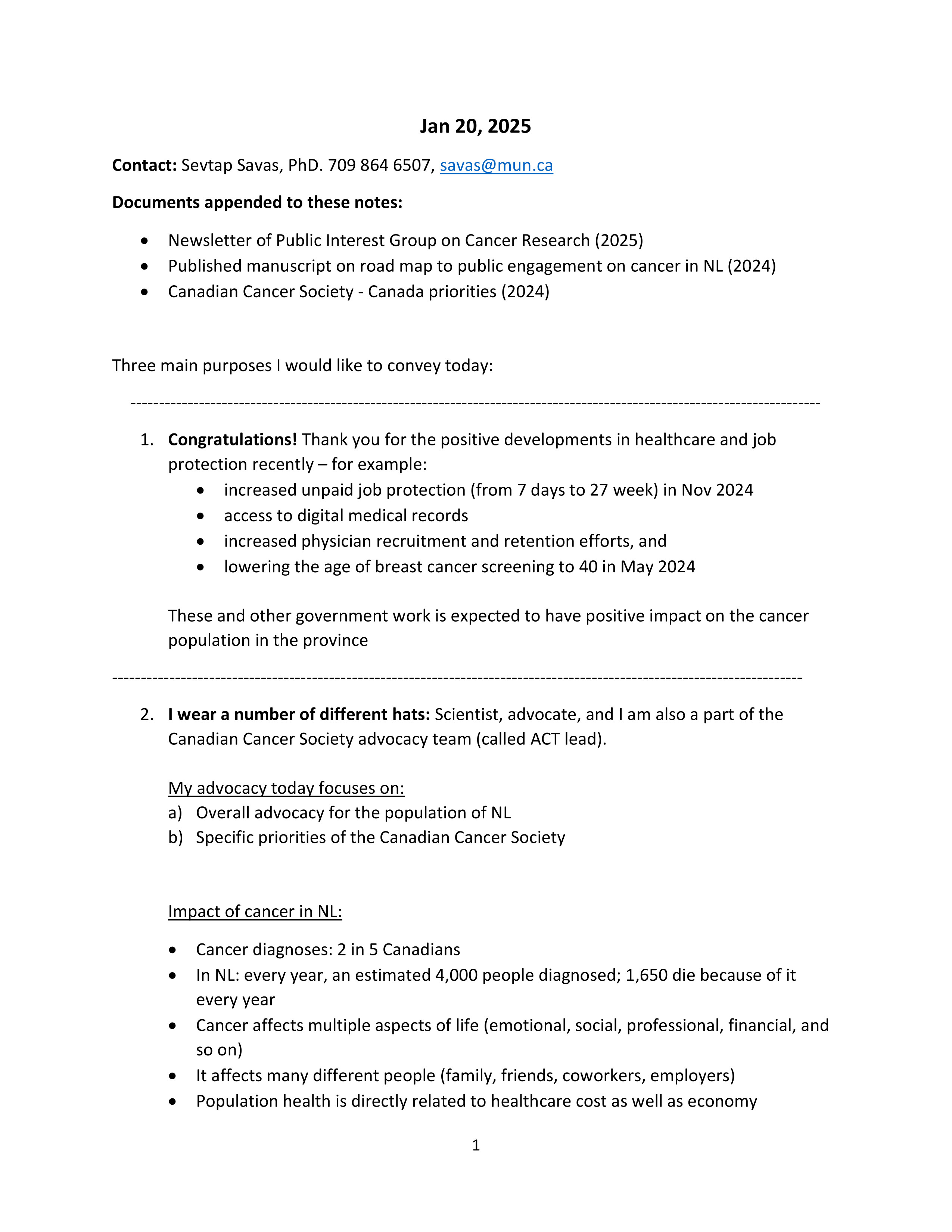
I was delighted to meet & speak with Minister Hogan and three other persons from the Department of Health and Community Services, Newfoundland and Labrador today as an advocate.
I appreciated the interest, warm welcome, and genuine listening.
Below is the 2-pager I left with them and what we talked during the meeting (mostly).
Two things I have emphasized during our meeting:
1. Reaching out to population and engage about health-related information where they are (not where we are)
2. Consulting and having patient and family ambassadors to connect with the population to engage in health-related information
In most cases what governments can do is all comes to the cost.
We need to invest on the wellbeing of our population, in terms of prevention early detection and support.
How much is your life worth? Our life? their life?
If there is anything that can be done, I am sure he will work on it.
One day at a time. Better days ahead. Sevtap Savas, PhD. St. John’s
PART III – LIFE WITHOUT A STOMACH (please see here)
PART IV – RETURN TO WORK AND IMPACT OF CANCER (please see here)
PART V – FOLLOW UP: GOOD DOCTORS, BAD DOCTORS (please see here)
PART VI – CURRENT STATE & FINAL WORDS (please see here)
PART VII – SILENCE OF THE MOTHERS (please see here)
PART II – LIFE WITH CANCER AND TREATMENT

MY SURGERY PHASE

Eight days after the diagnosis, it was time for surgery.

In my surgery, which started in the morning, my entire stomach, my duodenum, a part of my liver (because the 8.5 cm signet ring cell type tumor in my stomach had invaded my liver), and my gallbladder was removed (because it was understood that I had a stone in my gallbladder, so they told us to take it while I was on the operation table). I also had 25 lymph nodes removed. It was a very long surgery. I was first taken to intensive care for a few hours, and then to my room in the evening. I remember wreaking havoc in the intensive care unit because I was in pain.

During this time, my family's wait must have felt like a century. I would like to thank all my friends who came from out of town and from within the city and supported my family for my surgery.

I spent the first night after my surgery very comfortably. It was like I was in a sheltered white tunnel. I had a pump for a morphine-based painkiller connected to my lower back with an epidural. I was told to press if I had pain.

POST-SURGERY COMPLICATIONS

Two days after my surgery, I started having trouble breathing. Chest X-ray film was taken. The pulmonologist said that there was fluid accumulation around my lungs and that he would remove this fluid without hurting me. A lot of bloody fluid was removed from my left side and I started breathing normally again.

Then my kidneys stopped working. I took only serum for 7 days after the surgery. Everywhere was full of cables, pipes, probes, etc. One of these probes was going down from my nose to my surgery site. The amount of serum I received was compared with the amount of fluid in the bladder. There was a difference between the amount of fluid entering and exiting my body.

I saw that doctors attach great importance to this. In fact, after the last medication they gave me, they did not leave my room and waited for the medication to take effect. The treatment worked and my kidneys returned to normal.

I was discharged on a Friday, 11 days after my surgery.

However, on Sunday night I woke up with a high fever and not being able to breathe. I was taken to the hospital again by ambulance. I had pneumonia linked to the anesthesia/surgery. It was a more challenging process than my surgery phase, and I stayed in the hospital for another 14 days. A chest X-ray was taken every morning around five o'clock.

Since I couldn't stand upright on my own, my brother came in with me and held me while the X-ray film was being taken.


OUR EFFORTS WHILE LOOKING FOR A DOCTOR

While I was struggling with pneumonia in the hospital, my sister continued her search for a medical oncologist and radiation oncologist. We decided on a medical oncology professor who specializes in digestive system cancers at Hacettepe University Oncology Hospital. However, we could not make an appointment. My sister made many attempts.

Since we still couldn't make an appointment when I was discharged, I went to a doctor called the "Teacher of Teachers" in order not to be left without an oncologist. However, my meeting with the doctor and his answers to my questions demoralized me and I did not want to go on this treatment journey with him.

The only good thing he said to me was that my body was very strong. And on the same day, miraculously, we received the news that an appointment was made for the afternoon.
(image created by AI)
MY DEAR ONCOLOGIST

We were so happy. Actually, I didn't know anything about this doctor’s approach to patients. While waiting for the examination, I got hungry. My brother bought cookies in a hurry. While waiting with my brother's wife, we started eating cookies. It would be more accurate to call mine a scratch.

At that moment someone passed by and told me to stop eating it. He said to my brother's wife, "You can continue eating." And this person turned out to be my oncologist. 😊

When it was my turn, I went in alone. Because if he said something negative, I didn't want my family to hear it.

He examined all my medical reports asking long questions. I was diagnosed with Stage 2 of Stage 3. But he said, "I'm putting another 30% into his glass and moving his diagnosis to the 1st stage of the 3rd stage." I asked how much was in my glass. He said there was 20% but I made it 50%.

That's when I felt like a bond had formed between me and my doctor. And now I have been a patient of my oncologist for 15.5 years. He is a successful scientist who has risen very quickly in his academic career. I love and trust my doctor very much. It was a great chance to be his patient.

First, he arranged for me to meet with a dietitian who works with cancer patients. I learned about dumping syndrome from this dietician. I'll try to explain this later.

Later, he asked me to take the pathology samples from the hospital where I had the surgery and bring to a professor in the Hacettepe Hospital pathology department for re-examination.

At this stage, I would like to talk a little about our healthcare system so that what I wrote about hospitals and doctors can be more understandable.


OUR HEALTH SYSTEM

I think that the family medicine system in some countries makes it difficult or even almost impossible for the patient to reach a specialist doctor, and causes serious loss of time to the patient on such a vital issue as human health.

There is a family medicine system in our country, but no matter what the disease is, we do not have to get approval or referral from the family doctor to go to specialist doctors.

In the current healthcare system in Turkiye, there are State Hospitals, Private Hospitals, and most importantly, University Hospitals affiliated with Medical Faculties. We have the opportunity to visit specialist doctors of our choice (except State Hospitals) whenever we want, whether they are Associate Professors or Full Professors, for a fee, depending on the doctor's patient density.

Apart from hospitals, there are also private practices belonging to doctors who work with or without an affiliation with a hospital.
University Hospitals are always overcrowded as patients come from all over Turkiye.

Since I prioritized and chose a doctor for the first time for myself, these opportunities were very useful to me. I live in the capital Ankara and I was lucky because there are very good hospitals here.

The doctors I chose or referred to by my oncologist during my treatment process, including the doctor I went to for my thyroid nodule and the doctor who diagnosed me with cancer, were doctors who were trained at Hacettepe Faculty of Medicine, the number one medical school in Turkey, and had academic careers. The doctor who performed my surgery also graduated from the same Faculty of Medicine. This not only gave me confidence but also ensured that I did not waste time in my treatment.

In order to avoid any misunderstanding, I should also point out that there are many important and high-quality medical faculties in our country. It is up to the patient's choice which one to go for. You can also receive free treatment from specialist doctors in these hospitals. Chemotherapy and radiotherapy are free regardless of hospital. During my treatment, some fees were charged in private hospitals.

Another important issue is that you do not have to wait months for advanced examinations such as PET CT, MRI and CT scan. In University Hospitals, such examinations are performed at a smaller cost compared to private hospitals and imaging centers. If you are diagnosed with cancer, PET CT is free in all hospitals.


BEING BLAMED FOR HAVING CANCER

While I was waiting for the pathology results, people came to visit me. During one of these visits, a group of people not very close to me blamed me for having cancer. They acted like I deserved cancer. At first I was astonished, then I was very angry. I couldn't let my mother be upset any longer. I asked them to leave. They were very surprised by my attitude.

Why were they surprised? Were they expecting me to say “you are absolutely right”?


DOING RESEARCH ON THE INTERNET

Naturally, we want to know about our diseases.

I gave up when I saw a lot of information pollution on the internet. I started asking my sister what I was wondering about. An expert on the subject could give the most accurate answers. During my treatment, a CT scan noted bone thickening on the side of my left hip. When I looked on the internet it indicated bone cancer.

When I asked my oncologist, he said, "Tell me, on which side do you get the B12 injection?" I said from the left side. "That's why this thickening is happening," he said.

I never looked at the internet again.


MY FIRST CHEMOTHERAPY

After the pathology tests were obtained, my oncologist prepared the chemotherapy protocol. Before starting chemotherapy, we were given training on the issues we should pay attention to during treatment by competent nurses. The drugs given were more bearable with side effects than the heavy chemotherapy given after my radiotherapy (which I will describe later). It was a treatment in which no hair fell out, but that didn't matter to me anyway.

There were many side effects such as nausea (excessive retching since I couldn't vomit because I don't have a stomach), endless abdominal pain and diarrhea, weakness, headache and so on. The thing I had the most difficulty with was eating and drinking. Even if I forced myself to eat a bite, in addition to difficulty swallowing, this caused me to become bloated and I was in a very difficult situation to bear because I could not vomit.


THE FEELING OF ENTERING THE GRAVE

Meanwhile, I had a psychological problem. When I lay down, I felt like I was in the grave. It would be easier for me to deal with this if I just felt it. But, I was also experiencing things like severe depression, tightness and heaviness in my heart. For this reason, I spent the entire treatment period sitting, even though I was in no mood.

This situation still exists for me even after 15 years. I have been someone who has only been able to sleep with sleeping pills for more than ten years and I can never lie down except to sleep. When I lie down to sleep, it starts within a minute or two and all I can do is to wait and say it will pass. It goes away after a while. (I will explain my psychological treatment later).


I HAVE ANOTHER PHOBIA

One month after I started receiving chemotherapy, my first control CT scan was taken. This was the first examination result I received myself, prior to seeing doctors, other than the pathology reports I received (and talked about earlier). In the report, there was a mention of a 3.5 cm long mass in my liver.

After trying for three or four days, it was understood that that part of my liver was the surgery area. But unfortunately, this situation caused me to develop a phobia of receiving test results. For the next 15 years and still while receiving my test results, I am having a hard time even though I seem calm on the outside.

I planned to receive as many medical reports as possible without being alone. A very dear friend of mine came with me and supported me for years.

Medical examination results have been provided online for 3-4 years now. Now I look at the test results while video chatting with my sister, Sevtap. There are also times that I have to look at them on my own.


MY RADIOTHERAPY AND CHANGING CHEMOTHERAPY MEDICATIONS

Meanwhile, I had received the 3rd dose of chemotherapy. However, my oncologist said, "I can't risk you," and made changes to my chemotherapy drugs after radiotherapy. It consisted of the harshest drugs that could be given. Since the new medications affected my veins so much that there would be limited vascular access, a subcutaneous port (a type of catheter) was inserted into the area on my upper right chest.

At this stage, my radiotherapy started. Since the latest system radiotherapy machine was in a private hospital at that time, my treatment was performed there. My doctor who performed my surgery said that a radiation oncologist was very important. The beam program was conducted by Professor at Hacettepe Oncology Hospital, with whom we met before.

I received radiation for 23 days and also continued to receive light-dose chemotherapy with a pump attached to my port.  Sevtap came to Turkiye towards the middle of my radiotherapy.

Even if my sister was far away, she always gave me the greatest support, along with my mother. I want to say once again that I am grateful to her. We spent the remainder of my radiotherapy and the three-week break at the end of the treatment together.

I even knitted a beret and scarf for her as seen in the photo below. 😊

I haven't had the opportunity to write so far, but interestingly, I was a very high-spirited and cheerful patient. The joy part couldn't continue due to my new chemotherapy, but it didn't dampen my spirits at all. I don't know if I could have endured that heavy chemotherapy if I had been depressed.
MY NEW CHEMOTHERAPY
After my first session with new chemotherapy drugs, I did not see any side effects for 2 days. In the meantime, I shaved my head. But on the 3rd day, it hit me so hard that there is no way to describe it.

Can a person's breath hurt them? Is contact with another person painful enough to tear your flesh apart? Yes.. Imagine that I was taking 14 different medications against side effects. I cannot find words to describe the pain I was experiencing.

Death felt like salvation.

I also had to have an injection in my abdomen for ten days to raise my blood values. All roads ahead of me led to pain. Because of the extreme irritation of my esophagus, the things I ate and drank were literally tearing my esophagus.

As the chemotherapy sessions continued, skin discoloration began to occur, starting from the tips of my fingers and spreading to my entire hand, as well as on my face. It wasn't a big deal, but neuropathy had started in my hands and feet.

The numbness in my hands went away, but the numbness that started from my toes and continued to the top of my ankle did not go away. In fact, because of this numbness, it was 8 years after my treatment, I think I fell down at home and broke my ankle. 6-7 months ago, I fell headlong while getting out of a taxi. While everyone was trying to help, I was looking at the beauty of the sky :-)


MY RITUAL OF EATING (NOT EATING)

In the last days of the three-week break period given after each chemotherapy session, I dragged my feet and went to a restaurant close to my house and ordered food for myself. I would chew a piece of meat, but since I couldn't swallow it, I would put it on a napkin, pay the bill and go back home. This felt good because I could do something about normal life on my own.


MY STRUGGLE WITHDRAWING MONEY FROM MY BANK ACCOUNT

One day, I needed to withdraw money from my bank account.

The clerk at the counter looked at my photo on my ID card and said that I did not look like the person in the photo. I told him that I was being treated for cancer. I showed my professional ID too, but it didn't work. I showed the ID of my workplace, but it didn't work.

He stubbornly did not let me withdraw funds. I was very tired of both staying up and my efforts. As can be seen in my photo, this was way too much. I was only able to withdraw the money after talking to the bank manager.
PEOPLE'S ATTITUDE TOWARDS ME

After this bank incident, I would like to talk about some of the ways people behaved towards me.

Those who cannot look into my eyes because the name cancer is associated with death, those who do not know what to say... And even those who change their ways on the street...

Look, friends, look into our eyes. We don't hesitate to look into your eyes, so you don't hesitate either.

And please do not use the cliché that we too can die at any moment to supposedly console us. Sometimes it is best to remain silent rather than thoughtlessly comparing the abstract risk of death to people with a concrete disease.

Of course, the behavior towards me was not limited to these. I will explain it later when its time comes.


END OF MY TREATMENT

As my chemotherapy sessions increased in number, it became physically unbearable. Until that day, I had done whatever my oncologist had said. I had check-ups every month. Drinking the medicated water for the CT scan was almost torture. During my last CT scan, my stomach was in excruciating pain and it took a lot of effort to stand still during the scan.

When the test results came out, my oncologist said, "I will give you another dose of chemotherapy, then we will evaluate it according to the results." I said I don't think I can take it anymore.

I think I had already exceeded my physical limits and my doctor accepted it. It was like a miracle. My treatment journey, which lasted nearly a year after my diagnosis, had ended. I, who did not cry when I was diagnosed, cried with joy because my chemotherapy was over.

My mother and I showed joy when we left the hospital only. Because I had to think about the patients waiting for their turn for examination around my oncologist’s office. My joy could have been their sadness.

Years later, my oncologist told my brother, who brought a patient to him for treatment, that “we had put Mehtap through a lot”.

Treacherous cat 😊 Just kidding.  Thank you very much for being my doctor...


COMMUNICATION WITH OTHER PATIENTS

I think this is very important. We see that we are not alone, and since we are all fighting cancer, we become more sensitive about understanding each other. We can also learn useful things by sharing our experiences.

Last year, while waiting my turn for a CT scan, I was chatting with a lady older than me who had stomach cancer and had just completed her treatment. She said she loved salmon but couldn't swallow it. I told her to chew for a long time and if she still couldn't swallow, she should take it out without swallowing. She liked this idea very much. I still do this even now.

Once, a person who had stomach cancer like me said that coffee was good for digestion. Coffee really feels good when I have bloating.

Generally, patients ask each other how long they have had cancer. In the middle of my treatment, I had a conversation with a patient who had a 4.5-year history of stomach cancer. At that time, this period seemed incredibly distant to me, but it also gave me morale.

However, I have a dilemma when answering people who ask how many years it has been for me,

When I say that I have been living for a long time, this can cause different reactions in patients. Some of them find morale and strength in this.

However, it can cause demoralization, especially in people who are in the treatment phase or have metastases. Of course, I can't read their thoughts, but I can see from their behavior that they are demoralized.

That's why I'm very, very careful about what I say to other patients.


SCIENTIFIC ADVANCES

I received conventional chemotherapy and radiotherapy treatment 15 years ago. Science is advancing so rapidly that there are now new treatment methods. For example, Cyberknife, the world's first and only robotic radiosurgery system.

There are also great developments in radiotherapy machines. While CT scans of the lower and upper abdomen and thorax used to take a long time, now they are completed in 5 minutes. Instead of closed MRI machines, which give patients a difficult time, there have been machines with open sides for a long time.

There are chemotherapies with fewer side effects that are given orally in the form of pills rather than intravenously. Of course, I don't know all of them, but I greatly appreciate all the scientists who work devotedly and I would like to thank them, especially my sister.


MY SISTER'S PLATFORMS

At this stage, I would like to say that the platforms about cancer, led by my sister, are very important.

It fulfills a very important mission for social awareness, together with patients and their families. While informing the society, she does something that has been rarely done before by involving cancer patients and their families in her work. While advocating for cancer patients, she makes them visible to society.

I am proud of her and I sincerely congratulate those who took part in these activities by her side.
This guest blog consists of seven parts – hyperlinks will be added as they are published in order:
PART I – INTRODUCTION
PART II – LIFE WITH CANCER AND TREATMENT (please see here)
PART III – LIFE WITHOUT A STOMACH (please see here)
PART IV – RETURN TO WORK AND IMPACT OF CANCER (please see here)
PART V – FOLLOW UP: GOOD DOCTORS, BAD DOCTORS (please see here)
PART VI – CURRENT STATE & FINAL WORDS (please see here)
PART VII: SILENCE OF THE MOTHERS (please see here)
—————————————————————————————————————————————
PART I – INTRODUCTION
Hello, I am Mehtap Savaş, older sister of Professor Dr. Sevtap Savaş.
I greet you with love and want to share my stomach cancer story and experiences with you (I was diagnosed in 2009).
With this, I hope that people who have not encountered cancer can understand us, at least a little bit.
IS IT A HOSPITAL? MY GOD!  NO!

First of all, I would like to tell you about my hospital phobia and how I came to the diagnosis stage despite this phobia. When I was 5-6 years old, I had a tonsillectomy performed under local anesthesia, which made me very afraid. When I was taken to the operating room for the operation as a small child, I struggled so much and caused difficulties for the doctors that my surgery could only be performed on the third attempt, at a different time.  After this traumatic experience, I developed a hospital phobia and when I grew up, I almost never went to the hospital unless I had to.


MY DEAR SISTER'S ROLE IN CANCER DIAGNOSIS

I had nodules in my thyroid. My beloved nodules are a big family that has become more and more crowded over the years. My sister was insisting that I go to an endocrinologist for a very long time. Due to my hospital phobia, I was stubborn and did not go.

Finally, as a result of my sister's persistent efforts, I made an appointment.

When my doctor saw my tests indicating extreme anemia, he asked me directly: "Haven't you ever thought about which cancer I have?". I was 41 years old and even though I had stomach pains, I didn't even think about it. Thanks to the gastroenterologist who referred me to the doctor I went to for a completely different illness, it was understood that I had stomach cancer.

If I am alive today, I owe it to my sister, and on this occasion, I once again express my endless gratitude to her.  If I had not gone to the doctor (endocrinologist) at her insistence and had not been directed to another doctor thanks to the endocrinologist's attention, I would have passed into a stage from which it is unlikely to return.
(My mischievous sister :-). I took the photo when I was discharged from my second surgery. The one in his hand is the name card that was put on my wrist in the hospital. :-) )

MY DIAGNOSIS PHASE

First, I had a colonoscopy with endoscopy at the university hospital and samples were taken from my stomach for pathological examination. Later, in our healthcare system, patients generally receive their examination results from the relevant unit and show them to their doctors, so I picked up the pathology result in the same way.


BRAIN ENCLOSURE

When I looked at the pathology report, I saw that the result was cancer.

First I took one step to the right, then one step to the left. Then I stopped where I was. I don't remember how long I stayed like that. At this stage I had a brain eclipse. I couldn't think of anything. Then suddenly I came to my senses and started thinking about what I should do. I am a lawyer and therefore I take immediate action and focus on results.

It occurred to me to look for the university room of the doctor whose private practice I went to. Luckily, he was in his room and it was confirmed through his words that I had stomach cancer. While he was trying to explain to me that I had a chance of recovery with treatments such as surgery and chemotherapy, I asked what I should do. He said “let's get an MRI first”.

I went outside and realized at that moment that I didn't want to be alone. I called my office-mate at work, whom I love very much, and told her about the situation and asked if she could come pick me up.

While I was waiting for my friend, I saw that I was standing under a mulberry (a type of fruit) tree and started eating mulberries from the branches I could reach.

I was diagnosed with cancer, which is associated with death, and I was eating mulberries, not knowing what would happen to me.


FIRST STEP TO TREATMENT

While I was thinking about what path I should follow, my friend came and, thanks to my friend, I took the first step I needed to take in my cancer treatment journey.

She said, "If you trust me, let's go to my brother." My friend's brother was a general surgeon who was the clinical chief at a State-owned Training, Research and Oncology Hospital, and he performed my mother's un-critical surgery about 2.5 months ago. He said yes, there was something, and further examinations began the next morning.


HOW WAS I GOING TO TELL MY FAMILY?

This was the issue that challenged me the most at that moment.

How should I say it? First, I called my brother, who lives in another city, and explained the situation to him. Then I went home.. The hardest thing was to tell my mother and I couldn't find the right words.

I finally told my mom that the results were back, and I was diagnosed with cancer.

When I think about my mother's reaction, she never cried, never showed her sadness. And she said to me, "My inner voice tells me that you will get better, don't worry, we will get through this too." My mother was a woman who was strong as a mountain and always supported her children. She always hid the pain inside her and never showed it to me.

The strength of will shown by a mother whose child was diagnosed with cancer was incredible.

Of course, I also had to tell my sister about this result. I sent her a message and wrote that the results were not very good. My sister remained silent for a while. Then when she called, she said she wanted to come, but I told her there was no need to come right away.

My MoM
I will tell you about my dear mother, who passed away from cancer 3 years ago, and how she took care of me carefully in a separate article, as I do not want to squeeze in between the lines in this article.
The World Cancer Day is an opportunity for all us to remember, acknowledge, and honor those who are affected by cancer in and out of Newfoundland and Labrador.
The World Cancer Day will be celebrated on February 4th, 2025.
Late December, I submitted two requests within NL:
1 – Proclamation request with City of St. John’s,
2 – Building Lightening Request with the Confederation Building
I am pasting them here in download-able format in the hope that if any of you is interested in doing similar things but do not know how to start, they can give you an idea.
I have sent the letter below to The Honorable John Hogan, The Minister of Health and Community Services, Newfoundland and Labrador, asking to meet with him to advocate on behalf of NL citizens affected by cancer.
Considering the impact of cancer on individuals, families, and communities in NL, it is crucial that we improve cancer care and the ways we look after our citizens affected by cancer in the province.
I have had the pleasure of sending a letter to the Honorable Dr. Andrew Furey, Premier of Newfoundland and Labrador, to advocate on behalf of the individuals, families, and communities affected by cancer.
The most recent report by the Canadian Cancer Society on the financial impact of cancer, as well as the Memorandum of Understanding signed between the governments of Quebec and Newfoundland and Labrador gave me the idea of this advocacy letter.
You can download, revise, and use this letter to reach out to your elected officials.
Carey Majid, KC. Executive Director of NL Human Rights Commission:
Sevtap Savas, PhD. Cancer scientist and advocate:
We thank the event organizers (Krista King, Sevtap Savas), all speakers and participants, event funder (Office of Public Engagement – Memorial University) and supporter (NLSUPPORT).
Both in-person and virtual participation options are available
Location: Virtual (link to be sent upon registration) OR Faculty of Medicine, New Medical Education Building (also called “glass building”), 1st floor, Room 1M102
Event organized by Krista King at Faculty of Medicine, in collaboration with the NL Human Rights Commission.
Free Parking: Lot 30 (outside of medical school) and parking garage (level 2) from 9 am-2 PM
Speakers include those with lived experience, researchers, and the executive director of the NL Human Right Commission. Please see the current schedule below.