In this episode, Sevtap talked with Dr. Peter Barnes about grief, bereavement, and healing at the face if loss.
Take a look.

image by Kayla Crichton
In this episode, Sevtap talked with Dr. Peter Barnes about grief, bereavement, and healing at the face if loss.
Take a look.
image by Kayla Crichton
Guest Blog 7 – PART VI
By Mehtap Savaş
January 2025
Ankara, Turkiye
—————————————————————————————————————————————
This guest blog consists of seven parts – hyperlinks will be added as they are published in order:
PART I – INTRODUCTION (please see here)
PART II – LIFE WITH CANCER AND TREATMENT (please see here)
PART III – LIFE WITHOUT A STOMACH (please see here)
PART IV – RETURN TO WORK AND IMPACT OF CANCER (please see here)
PART V – FOLLOW UP: GOOD DOCTORS, BAD DOCTORS (please see here)
PART VI – CURRENT STATE & FINAL WORDS
PART VII – SILENCE OF THE MOTHERS (please see here)
—————————————————————————————————————————————
PART VI – CURRENT STATE & FINAL WORDS
MY DAILY LIFE AFTER TREATMENT
While life goes by, a significant part of my life is spent in hospitals. After my treatment ended, I went for check-ups every month for a year. Immediately after the check-up, I had to do the next check-up, make appointments, and donate blood for creatinine measurement before CT. The following years passed in the same way.
Meanwhile, other diseases entered my life. I last had a lung infection over a year ago. I had pneumonia 2 months ago. A pulmonologist also joined the doctors I go to regularly. I have had thyroid checks for 15 years. I also go to the psychiatrist. A few weeks ago, I had a problem in my right eye. I will go for check-ups for that from now on.
My sister jokes that “I get better healthcare than the Queen of England” 😊
From the first year onwards, among all the examinations, you always think about what will happen in the next examination. You feel more comfortable having annual check-ups. It is a constant reminder that not having a stomach requires careful eating and drinking.
My home in Ankara has become synonymous with hospitals for me. I adjust the medical appointment dates accordingly so that I can go to the summer house during summer months.
Low or high values in some of my blood tests affect my depression. I say “come one by one” but they don't listen to me :-) .
While I was preparing this article, my brother came from out of town to visit me. I had thyroid control and he supported me. I had a thyroid biopsy two days ago. The endocrinologist showed my nodules on ultrasound and said it looked like a potato field :-) Sweet potatoes? :-) Purple potatoes? :-) Yellow potatoes? :-) .
We started medication because my T4 level, one of my thyroid hormones, has been low for a long time. These low levels cause extreme fatigue and I feel dizzy when I stand up. My doctor asked for a check-up after 2 months. I have been on an iodine regime for 8 months. It was found to be extremely high in the tests. Still high :-( It causes low T4 hormone.
My life in Ankara is quite routine. I'm usually at home and spend time with my hobbies. I never watch television. I love listening to music. Sometimes I go on a song hunt You also do things that make your life better.
I love being in the summer house because there is no hospital on the island except for the health center and one family doctor. I feel free because I don't have to go from hospital to hospital.
Another thing that makes me happiest at the summer house is taking care of and feeding stray animals. Last summer, I stayed on the island for the first time for nearly 5 months. I was doing pretty well. I have an interesting relationship with stray animals. When I come across a cat I haven't seen before while returning from somewhere, I say, "Come on, let me feed you." They walk beside me and come with me.
I don't swim much in the summer. In September and October, I walked by the sea a lot and collected stones and seashells. One day, 3 pitch black dogs and 1 brown dog in the distance on the empty beach started running towards me, barking. They didn't attack me, they just surrounded me, put their paws on my chest and asked me to pet them. One of them stuck his head inside my fleece coat. I loved them all, I talked to them. Another day a dog hugged my legs. 15 min. He didn't leave me 😊 I love them so much.
I have walked away from most of the toxic people in my life. This can be perceived as relative loneliness. But it is not. Being alone is not a problem for me, except for the absence of my mother. I would rather be alone than exposed to toxic people. I never get bored, I have so much to do. In the summer, I make home vinegar from my fruits. I don't use it, but my brother likes it very much. I give away some of it. Last summer I tidied up the front yard of the house. It took me a lot of time due to my fatigue, but I was happy while doing it.
One of my dearest friends told me that I was a geek. I like and enjoy doing research on a subject that I am interested in and curious about. I am not antisocial, on the contrary, I can communicate with people very quickly. Mine is a conscious loneliness. Because I'm tired of people's selfishness, their efforts to present themselves as something they are not and cannot be, and their desire to dominate me. My independence is very important to me and I do not like and do not want people in my life, who try to interfere with my personal space.
After all, we are members of a society and we have to do many things even though we do not want to. The important thing is to minimize these as much as possible and focus on things that will make us happy. Sometimes doing nothing is also an option :-).
LAST WORDS
The first thing that keeps me alive is that my mother took very good care of me, her support and the support of my siblings, the second is having access to very good doctors, and the third is having high morale, according to my oncologist.
One of the reasons why I tell my story of signet ring cell type stomach cancer, which has a low survival rate, is that we always have a chance of recovery, no matter what type of cancer and at what stage it is.
I know there are some of you who are going through much harder things than me. We are not just statistical data. We may surprise some scientists by not being where these data indicate, and we may change the statistical data with the help of advancing medical science. We must believe in our own power.
In this struggle, patients should also demand social support assistance. They should be able to access advanced examinations and specialist doctors as soon as possible, regardless of the disease. The first priority of governments, including my own country, regarding health should be people's right to life and their fulfillment of these requirements.
Since cancer treatment is very long and financially challenging, patients in need should be supported by the governments. I guess I'm asking for too much
Another important issue is, of course, social awareness. For this reason, I find my sister Sevtap's work in this direction very important. I really appreciate how passionately she works for the platforms she leads.
Thank you very much for listening to me in this long story. I am very happy to be among you who share your illness stories here. Stay healthy, happy and well.

The cost of cancer can be hidden in many ways.
One great advocate I know in Newfoundland and Labrador (Tracy Slaney) once said that they need a “reliable car” to help travel to and from St. John’s for treatment of his husband, Jim.
I keep thinking about this. Especially on snow days.
Not just a car. A reliable car.
A car that will take you to your destination safely.
——————————————
I have been reading the Canadian Cancer Statistic’s special report on the economic impact of cancer in Canada with a great interest.
While I am not directly doing research in economic impact of cancer, nevertheless, the challenges faced by patients and families – including the financial cost and barriers while receiving care and surviving beyond cancer – are very important for my advocacy and my understanding of the cancer experience.
Here are some of the key points I gathered from this report:
For example;
7. There are some communities facing systematic barriers to access care and clinical trials, for example, those living in rural areas, low income families, and marginalized communities – these communities may be at increased risk of having cost of cancer. Of note, Atlantic Canada has a high proportion of its population living in rural areas (around 45%).

——————————————
So what do we do with this information?
It seems that cancer will continue to rule our lives.
Is there a chance that we can help prevent this?
The authors state that this information will help planning by both the healthcare leaders and families affected.
I agree.
I think we should also focus on additional solutions:
For better days ahead, we need to combine our hands, hearts, minds, and forces.
Please advocate for yourself and others to prevent, early detect, and treat cancer.
If one of us is helped, all of us are helped.
Let’s help each other.
Sevtap Savas, PhD. February 14, 2025, St. John’s

We are pleased to start Season II of our podcast series!
In this episode, Andrea Edwards joined Sevtap to share her story with cancer as a single mom.
Her resilience and advocacy shine. Listen to Andrea:
On behalf of the Public Interest Group on Cancer Research, thank you Andrea.
***For schedule, please see here: https://strength-in-community.ca/2025/02/18/conference-schedule-cancer-is-personal-humanizing-precision-medicine-in-atlantic-canada/
——————–
We are pleased to invite all Atlantic Canadians to this free, virtual, and public conference on cancer and Precision Medicine on March 15, 2025!
This conference is organized by the Atlantic Cancer Consortium Patient Advisory Committee (ACC PAC), consisting of 14 members from across Atlantic Canada.
The conference will include speakers representing cancer patients, caregivers, researchers, healthcare and support service providers, leaders, and advocates.
Opening and closing keynote speeches will be delivered by a panel of patients and our special guest (Darrell Fox, the younger brother of Terry Fox), respectively.
Topics include lived experiences of patients and caregivers from various backgrounds, clinical trials in cancer, precision medicine in cancer, clinical and support services offered to cancer patients in Atlantic Canada, and role of advocacy in changing things for the better.
Select speeches will be delivered in French.
Register here: https://mun.jotform.com/250295627862061
Thank you – Organizing Committee: Jennifer Coish, Beverly Pausche, Georgia Skardasi, Sevtap Savas.
***For updates, info, and conference schedule, please continue to visit this website.

QR code for the registration link:

Tentative schedule (Feb 14, 2025) – subject to change
Guest Blog 7 – PART V
By Mehtap Savaş
January 2025
Ankara, Turkiye
—————————————————————————————————————————————
This guest blog consists of seven parts – hyperlinks will be added as they are published in order:
PART I – INTRODUCTION (please see here)
PART II – LIFE WITH CANCER AND TREATMENT (please see here)
PART III – LIFE WITHOUT A STOMACH (please see here)
PART IV – RETURN TO WORK AND IMPACT OF CANCER (please see here)
PART V – FOLLOW UP: GOOD DOCTORS, BAD DOCTORS
PART VI – CURRENT STATE & FINAL WORDS (please see here)
PART VII – SILENCE OF THE MOTHERS (please see here)
—————————————————————————————————————————————
PART V – FOLLOW UP: GOOD DOCTORS, BAD DOCTORS

MY ONCOLOGIST TAKES ONE YEAR UNPAID LEAVE

During my 6-month check-ups, my oncologist took a one-year unpaid leave from the hospital. I was so sad and shaken. Since my doctor was very important to me, I could not imagine his absence. Due to the stress I was experiencing, I developed skin break ups in my abdominal area.

Fortunately, he opened a private practice before my next 6-month check-up. Now I can make an appointment without any problems. During the years when my oncologist was practicing at the hospital, he would also perform examinations at 5 or 6 am in the morning due to lack of time. I went to him a lot in these early hours.


BEING STUBBORN WITH MY DOCTOR :-)

I have never delayed my check-ups. But sometimes I get stubborn with my oncologist about the tests. He is very detail oriented and does not miss the smallest thing. I didn't want to have some tests done. But I never succeeded :-)  Keep trying :-)


HOW DID MY ANNUAL CHECK-UPS DECREASE TO 3-4 MONTHS AGAIN?

About 3 years ago, during my check-up after my mother's death, my CA 16-19 levels, one of the tumor markers, were high. Thereupon, a special MRI was performed on the liver, pancreas and gallbladder area and a gastroenterology consultation was performed along with other tests. Nothing untoward happened, but the check intervals were reduced to 3 months. My doctor only agreed to take a 4-month break at my request so that I could go to the summer house in the summer.

All my tomography and MRI scans were performed at Hacettepe Hospital, with a few exceptions. But 1.5 years ago, for the first time, I could not find a paid private MRI day. They could give a date 3 months later. I had to have it done at a private imaging center for a very high fee. And I uploaded the previous MRI image and the result report to the imaging center's system.
MRI SHOCK

A few days later, the results arrived in my e-mail. When I read it, it said that I had widespread metastases in many parts of my liver. This time I really had a big shock. At that time, I was a devastated person who could not accept the death of my mother and was experiencing the greatest pain of my life. I also had panic attacks that started with my mother's illness.

I made an emergency appointment with my oncologist. When I went, he had already read the results of the examination that had been sent to his e-mail. He told me that stomach cancer will not metastasize like this after many years. He called the imaging center and asked them to examine it again. He asked me to get the MRI images from the center and asked for them to be examined by a Professor Radiologists at Hacettepe Hospital.

When I returned home, I compared the areas called metastases with my previous MRI result. They even interpreted the hemangioma (a benign growth formed by the expansion of blood vessels) that had existed in my liver from the very beginning as metastasis.

When I went to the Imaging Center, they asked me to come back 3 days later for the MRI CD taken there. I said that I did not have time and that I wanted both the CD and the MRI results immediately. And I reminded him that the previous MRI images were loaded in the system.

Frankly, I was annoyed that 3 employees sitting next to each other asked me to wait 3 days to load a simple CD with my imaging results. If I received the CD late, it would cause me to lose time as it would be re-examined at Hacettepe Hospital. This was a waste of my time.

Half an hour later, one of the employees brought the corrected report and the MRI CD. I said I wanted to meet the doctor. They refused, but I insisted. I couldn't remain silent on such an important issue. Our lives are filled with examinations and such a doctor's error was not acceptable.

The doctor came and explained the report to me, stating that she did not interpret the lesion in the right adrenal gland as problematic. However, this didn't matter to me anymore. The MRI would be re-examined at Hacettepe Hospital. Not only would this bring another financial burden, but the consequences of my psychological state would not be easily resolved.

I asked her, "Can you imagine what kind of mood a cancer patient would be in when they see such a result?" I also asked her if this was a control MRI and what she compared it with to reach her conclusion. She apologized to me and said that her staff did not inform her about the previous MRI. I said, as a doctor, I would expect you to ask me for this even if I did not provide the previous images. I told her that I was suffering from major depression and panic attacks, and that such events caused my depression to escalate.

She apologized again and said she had learned her lesson.

I wish she hadn't learned her lesson from me.


HACETTEPE HOSPITAL RADIOLOGY DEPARTMENT

We have the opportunity to choose the doctor when we have an MRI at Hacettepe Hospital or when we want the ones taken outside to be re-evaluated. Especially radiology professors are very good in their field. When one of these doctors evaluated the MRI, he stated that no mass or distant metastasis was detected in my liver, however, there was a millimetric lesion in the right adrenal gland and a close follow-up was recommended.

There are many diseases originating from the adrenal gland. Adrenal hyperplasia, adrenal Cushing syndrome and pheochromocytoma are examples.

The reason why I mention these is that while one doctor gave an examination result in the direction of metastasis, another doctor reached the correct conclusion with a detailed examination to indicate which disease the lesion in the adrenal gland indicated.

Since my oncologist is very careful and experienced, he examines the imaging results performed outside Hacettepe Hospital and often has them re-examined at Hacettepe when necessary. You can see the benefits of re-examination or re-interpretation of medical results.
MY 3RD SURGERY

As a result of the re-examination performed at Hacettepe Hospital, my oncologist referred me to a professor who was an endocrine surgeon at the same hospital. I had likely an adrenal gland-related disease that can be detected very rarely and can cause high blood pressure that does not decrease and sudden deaths due to reasons such as stroke and heart attack.

If I didn't have cancer and didn't have regular checkups, it might not have been detected, either. Especially considering my hospital phobia...

The endocrine surgeon listed the tests I needed to have first. Since the adrenal gland is an organ that has nothing to do with the kidney and is responsible for the production of many important hormones in the body, the tests were generally related to hormones.

When the tests were completed, my surgery was performed 1.5 years ago. My doctor performed my surgery in a private hospital, not Hacettepe Hospital. The doctor said that he would first start with laparoscopy and then convert it to open surgery depending on the situation. Ultimately, it was converted to open surgery. My brother, who lives in another city, came for my surgery. We used the hospital's companion service for a companion to stay with me.

Before the surgery, I talked to the head nurse and told her that I could not eat sugary things because I did not have a stomach, and I asked for my meals to be arranged accordingly. But since they didn't take this into consideration, dishes like sugary pudding were coming and I couldn't eat them. My doctor said I can't discharge you unless you eat something.

Of course I couldn't eat it. I had no appetite at all. I stayed in the hospital for three days, but the painkillers made me confused. Those days felt like a month to me. My close friends from my workplace came to support me both in the afternoon and in the evening.

A week later, my brother had to return because of his work. We were alone at home with my two cats. When I returned from the hospital, one of my cats, Monica, never left me alone day and night and always slept next to me. She usually sleeps in her bed on the floor of my bedroom.

After the surgery, a hematoma (blood collection) formed in my stitch area and my doctor said it would go away over time. About 10 days later, dark blood started leaking from one of the laparoscopy holes. I went to the doctor and he explained to me how to drain this blood. I did what he said twice a day for about 10 days until the discharge stopped.

What was more difficult was running between buildings to perform the procedures when the pathology report came out and my oncologist wanted it to be re-examined at Hacettepe Hospital. I had a balance problem, I was walking swaying and I was in no mood. Then, my thyroid check was started immediately and a biopsy was performed. As someone who just had surgery, it was very tiring.

Then my 3-4 month check-ups continued. At my last check-up, my oncologist requested so many tests that I was going to 3 different hospitals a day. And finally I went back to yearly check-up schedule.
Today we honour those who are impacted by cancer globally, including my very courageous sister in Turkiye.

Here are some of my messages for today:
– Newfoundland and Labrador has the 2nd leading cancer rate among the Canadian provinces
– Lung, breast, colorectal & prostate cancers make around 50% of cancer cases
– There are many other cancers affecting us, which are equally important and impactful
TO ALL CURRENT PATIENTS and FAMILIES out there AFFECTED BY CANCER:
– We see and hear you
– Impact of cancer on you and your loved ones are significant
– These include emotional, social, financial, and other impact
– We are determined to advocate on your behalf, and do research, teaching, training, and service
– There is a growing number of advocates in NL, that gets national attention now
– Please check the services offered by the Provincial Cancer Care Program in NL: https://cancercare.easternhealth.ca/
– Better days ahead
THESE ARE WHAT I WANNA SAY TO FUTURE CANCER PATIENTS AND FAMILIES:
– Should we let cancer rule our lives?
– Are there things to do to prevent it? For example, thru addressing smoking, alcohol consumption, sedentary life style, diet & other exposures (including some infections)
– Screening and early detection can save lives
– Anything unusual? please see your healthcare provider, regardless of your age
– Please advocate for yourself and others
AND THESE ARE WHAT I WANNA SAY TO GOVERNMENTS AND HEALTHCARE SYSTEMS:
– address the social determinants of health
– solve the primary care access issues
– address the financial cost of cancer and other needs of affected families and individuals
– information campaigns on cancer are critical, especially in this age of misinformation and disinformation
– Invest in people and healthier population, so that we can be a stronger country, economy, society, and more
– MEET PEOPLE WHERE THEY ARE, NOT ON A WEBSITE 
I am also grateful for:
#NewfoundlandAndLabrador #Advocacy #Cancer #Awareness #WorldCancerDay
Better days ahead
Sevtap Savas, PhD. Feb 4, 2025, St. John’s

Guest Blog 7 – PART IV
By Mehtap Savaş
January 2025
Ankara, Turkiye
—————————————————————————————————————————————
This guest blog consists of seven parts – hyperlinks will be added as they are published in order:
PART I – INTRODUCTION (please see here)
PART II – LIFE WITH CANCER AND TREATMENT (please see here)
PART III – LIFE WITHOUT A STOMACH (please see here)
PART IV – RETURN TO WORK AND IMPACT OF CANCER
PART V – FOLLOW UP: GOOD DOCTORS, BAD DOCTORS (please see here)
PART VI – CURRENT STATE & FINAL WORDS (please see here)
PART VII – SILENCE OF THE MOTHERS (please see here)
PART VII – SILENCE OF THE MOTHERS (please see here)
—————————————————————————————————————————————
RETURN TO WORK

I was a Civil Servant working as a lawyer at the headquarters of a large institution with a very high workload. Even though I had a long sick leave, I returned to work quite early.

When I started working, our female General Counsel, who was our supervisor before my illness, was very understanding, helpful to me, and supportive. But the attitude of some of my colleagues, especially their lack of empathy, was annoying. I didn't care about it at the time.

It was great to get together with my favorite friends at the workplace. We were having a good time together. I regained my old joy. I also started to do things that I couldn't do before. I was making time for myself, going to concerts and having fun with my friends. We also took tennis lessons together.


MY TREKKING ADVENTURE

When I felt good physically, I started trekking. It was very difficult at first, then I started walking as good as my group mates. We were having so much fun. Every week we were walking up the mountain on a different track and getting clean air. I attended regularly for 2.5 years. Once we got lost as a small group in front. Our situation was very funny 😊 One of our guides found us.
MY WORKPLACE AND MY PSYCHOLOGY

I think it was 3 years after my treatment when our supervisor retired. One of my colleagues was appointed in her place. Let’s face it; lack of understanding and accommodations may be a reality for employees affected by cancer at the workplace. I struggled for a year. I felt that even going to the hospital for my tests could be a problem. And my psychology collapsed. As someone who has faced death, my tolerance limit has fallen very low. It was like I was being punished for having cancer. After a nervous breakdown at work, I went to a psychiatrist.

Even though the supervisors changed, I continued to feel issues until I retired 5.5 years ago. I struggled constantly in the last years of my working life.

MAJOR DEPRESSION

My desire for life decreased, I became someone who couldn't sleep, couldn't laugh, didn't want to do anything, and cried over ridiculous things, even though I didn't even cry when I was diagnosed with cancer. Also, the idea of jumping from the 11th floor was constantly floating around in my mind. I didn't have a suicidal idea, but it was involuntarily messing with my brain.

That's why I kept myself away from windows. If we ask why the 11th floor, the answer is that it is the floor where my office is located.

After listening to me for a long time with my questions, the psychiatrist said, "In cancer patients, the psychological process is experienced as REBELLION – DENIAL - DEPRESSION and ACCEPTANCE, but it seems that you have directly moved to the acceptance stage."

He explained that my problems at work had triggered this process that I was experiencing incompletely, and that this process that I had to go through before was now starting to be completed.

He diagnosed me with major depression and started me on medication. He also gave me a 2-month sick leave report and asked me to stay away from my workplace and reminders of negative experiences.

Later, a male colleague of mine at work said that there were no tests for depression, how could doctors make the diagnosis without a test, that there was no such disease, that I had actually lost my determination to work, and that I would get better if I worked harder. Isn't it a joke?

Some people confuse unhappiness with depression. And the most common thing I'm told is that everything ends in the mind and that I shouldn't worry about it. Such people: please do not try to give us advice. Depression is not a whim.

Unfortunately, I have had this disease (depression) for 10.5 years. Because for the reasons I will try to explain, my depression can escalate and, according to my psychiatrist, it is recurring again and again. I go back to the moment I was diagnosed with cancer. After my mother's death, I went to therapy for nearly two years. I want to get better, but I still haven't been able to do it.

CAN I HAVE A HOBBY IF I HAVE A PHOBIA?

When I started to feel a little better after being diagnosed with major depression, I took up hobbies to keep my mind busy. I dealt with things like purse designs, wood painting, sewing, knitting, and watercolor painting. This felt good to me. I was giving the bags as gifts to the people I loved. I still continue with old and new hobbies.


MY SECOND SURGERY

In the ultrasound taken during a check-up in the fourth year after my treatment, the assistant doctor detected 3.5 cm mass in my ovary. I experienced another shock. MRI showed that there was no such mass. But my doctor wanted me to have surgery for preventive reasons, saying that it could reduce my future potential cancer risk. It was a very mild surgery compared to my first surgery. My sister accompanied me in the hospital. We had so much fun the night before the surgery. Thank you my dear sister :-)


OUR RIGHT TO SICK LEAVE

We have up to 12 months of paid sick leave for each illness and up to 36 months for diseases like cancer. After one year, this right is renewed. For this, a committee consisting of three doctors must report.

I was experiencing depressive attacks from time to time during my severe depression. By the way, I mentioned above that I had a second surgery. When I fell due to neuropathy, I broke my ankle ligament and there was also a fracture where it broke. Since I could not work in these cases, a sick leave report was given. From time to time, a report was given by my oncologist.

I mostly experienced issues at work because of my sick leave. They also suggested that I could retire due to disability. As a lawyer, I knew my rights. It was frustrating. I retired 9 years after my treatment because my work was affecting my health negatively.


AN EXAMPLE OF MY DEPRESSION ATTACKS

Orthopedist who thinks he is an endocrinologist: At one point, I had bone pain throughout my body, mostly in my hip bones. I went to an ORTHOPEDICS professor in a private hospital. Films were shot and other examinations were conducted. The doctor ordered a PET CT scan because I had intense bone pain and because of my medical history. I discussed this with my oncologist before the scan, and when he approved, I got the scan.

As a result, only a minimal increase in retention in the thyroid was noted. The doctor told me I had thyroid cancer. I found myself in the corridor with the report in my hand and stood there again. I am someone who has had my thyroid checked regularly for 15 years. Where did this come from?

I took the results to my surgeon who performed my stomach surgery at the first opportunity and my doctor said the results were great. I didn't have cancer or anything. It is an organ that retains radioactive substances given to the body due to its thyroid function. It was a huge mistake and even arrogance for the orthopedist to diagnose me with cancer on a subject that had nothing to do with his field of expertise.

My psychiatrist said it took me back to the moment I was diagnosed with cancer. And he named another doctor, saying that the most cruel doctors come from among surgeons.
Guest Blog 7 – PART III
By Mehtap Savaş
January 2025
Ankara, Turkiye
—————————————————————————————————————————————
This guest blog consists of seven parts – hyperlinks will be added as they are published in order:
PART I – INTRODUCTION (please see here)
PART II – LIFE WITH CANCER AND TREATMENT (please see here)
PART III – LIFE WITHOUT A STOMACH
PART IV – RETURN TO WORK AND IMPACT OF CANCER (please see here)
PART V – FOLLOW UP: GOOD DOCTORS, BAD DOCTORS (please see here)
PART VI – CURRENT STATE & FINAL WORDS (please see here)
PART VII – SILENCE OF THE MOTHERS (please see here)
—————————————————————————————————————————————
PART III – LIFE WITHOUT A STOMACH

AFTER TREATMENT
After my treatment, my pain and fatigue continued for a long time, as seen in my photo. It took me a long time to feel good physically. It was not possible to fully return to the past anyway.

After the end of the treatment, I had monthly check-ups for a year. In the following years, we started check-ups every two months, then every three months, every six months, and then after 6 years, we started annual check-ups. After the twelfth year, I went back to 3-monthly check-ups all over again.

I want to start by saying that a lot happens. Since our digestive system loses its most important part, digestive and excretory problems begin. Not being able to drink water, difficulty swallowing, taking external supplements throughout life (because the food we eat needs to be processed in the stomach in order for the body to produce /absorb vitamin B12 and iron), bloating that sometimes starts with the first bite, not being able to vomit, gas problems, and completely eliminating some foods from your life.

Since there is no gastric valve (actually known as a valve, it is a condition that occurs when the muscles at the entrance and exit of the stomach are stretched), when you bend over for a long time, the food you eat or acid secretion comes into your mouth, and acid splashes cause great pain in your throat, especially at night. And most importantly, experiencing dumping syndrome is one of the first things that come to my mind.

And to patiently answer the question of where does the food you eat go if you don't have a stomach?

I would like to detail some of these to make them more understandable.

Dumping Syndrome: This is a very important syndrome we experience. The reason is that since we do not have a stomach, the food we eat passes directly into our small intestine, and since absorption begins immediately in the small intestine, if you eat something that will raise your blood sugar, your blood sugar will suddenly skyrocket.

The pancreas secretes insulin to lower high blood sugar, and this time your sugar drops too low, so you go into hypoglycemia. During hypoglycemia, my back feels like it's on fire, I start shaking and feeling extremely dizzy. To fix this situation, you need to raise your sugar again. You return to normal about 20 minutes after eating sugar.

Not being able to drink water: Since I don't have a stomach, when I drink water it goes straight down and causes pain. To avoid this, I have to drink it in small sips. Water is incredibly unpleasant when drunk this way. I was drinking fruit compote with very little sugar for fluid intake. Then I started drinking iced tea. At least it didn't require small sips since it had a taste. Even though I can now drink a few sips in a row, I still cannot drink water.

I'm not alone in this. There are many patients in my situation. One person said that he started drinking water after 15 years. I hope I can drink it too one day.

And I will be free from the pressure of people who constantly tell me why I need to drink water and say that I cannot live without water. I want to ask them. If you can't live without water, how have I been living for 15 years?

Difficulty swallowing: This is actually pretty detailed. In short: The muscles required for swallowing in the esophagus do not stretch, and the food you swallow remains stuck at the beginning, middle, and sometimes at the end of the esophagus. I sneeze repeatedly as a result of my body's reaction, especially if I swallowed quickly. People generally think that I sneeze because I am sick.

The worst thing is that the thing you swallow reaches your windpipe before it enters the esophagus and you are left breathless, trying to stay calm and expel what you ate, bloating, not being able to vomit (10 years later, I started vomiting by stretching my abdominal muscles), even after 15 years, it is more common than before.

Imagine experiencing the same symptoms repeatedly while eating something.

One day, while I was waiting in line for a CT scan at the hospital, an old lady sitting next to me said that she could only eat one apple the night before. I waited 8 years to eat an apple. I still can't eat an apple at once.

And those who force me to eat and eat sweets outside my immediate circle. This can be very overwhelming and actually shows that they are not really listening to me even though I have explained my situation over and over.

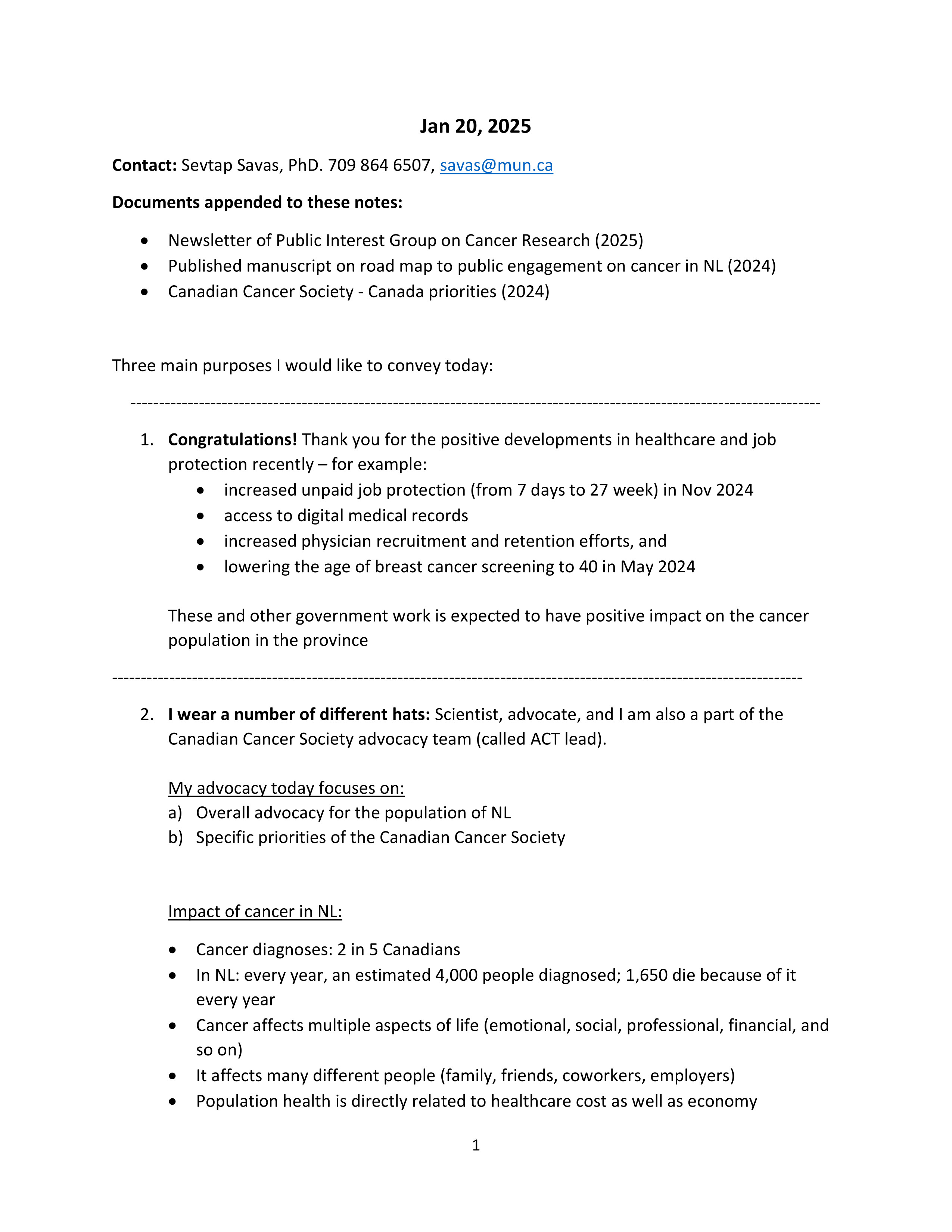
I was delighted to meet & speak with Minister Hogan and three other persons from the Department of Health and Community Services, Newfoundland and Labrador today as an advocate.
I appreciated the interest, warm welcome, and genuine listening.
Below is the 2-pager I left with them and what we talked during the meeting (mostly).
Two things I have emphasized during our meeting:
1. Reaching out to population and engage about health-related information where they are (not where we are)
2. Consulting and having patient and family ambassadors to connect with the population to engage in health-related information
In most cases what governments can do is all comes to the cost.
We need to invest on the wellbeing of our population, in terms of prevention early detection and support.
How much is your life worth? Our life? their life?
If there is anything that can be done, I am sure he will work on it.
One day at a time. Better days ahead. Sevtap Savas, PhD. St. John’s